Simarouba glauca (Lakshmi Taru): The Complete Guide to India's Paradise Tree
Simarouba glauca, known in India as Lakshmi Taru or Laxmi Taru, is an evergreen oilseed tree whose kernels yield 55-65% edible oil. Full guide to identification, growing conditions, yield and uses.
ಕನ್ನಡದಲ್ಲಿ ಓದಿ: ಸಿಮರೂಬ ಗ್ಲಾಕಾ (ಲಕ್ಷ್ಮೀ ತರು) — ಸಂಪೂರ್ಣ ಮಾಹಿತಿ
What is Simarouba glauca?
Simarouba glauca is an evergreen oilseed tree native to Central America, grown in India as Lakshmi Taru (also spelled Laxmi Taru). It commonly reaches 12–15 metres, tolerates drought and poor soil, and produces fruit whose kernels contain roughly 55–65% oil — a semi-solid fat, high in oleic and stearic acid and closer in profile to palm than to olive. Trees begin bearing in year 4–6. In English it is called the paradise tree or bitterwood.
It is not a native Indian species and has no classical Ayurvedic pedigree, despite frequent claims otherwise. It was introduced to India in the 1960s and promoted from the 1980s onward as a wasteland oilseed and biodiesel crop.
Quick facts
| Botanical name | Simarouba glauca DC. |
| Family | Simaroubaceae |
| Indian names | Lakshmi Taru, Laxmi Taru (Hindi); ಲಕ್ಷ್ಮೀ ತರು (Kannada); லட்சுமி தரு (Tamil) |
| English names | Paradise tree, bitterwood, dysentery bark |
| Spanish/native name | Aceituno, negrito |
| Origin | Central America — El Salvador, Guatemala, Costa Rica; also S. Florida, Caribbean |
| Habit | Evergreen, commonly 12–15 m, single trunk, spreading crown 7.6–9.1 m across |
| Sexual system | Polygamodioecious — male, female and mixed trees are separate plants |
| First bearing | Year 4–6 from seedling |
| Economic life | Commonly quoted as 50–60 years — unsourced, treat with caution |
| Oil content | 50–65% of seed; 55–65% of kernel; 60–75% reported by one source |
| Spacing | Sources differ — 5 × 5 m (400/ha) or 6 × 6 m (277/ha). See below |
| Rainfall | Sources differ — 500–2,200 mm (India) to 1,200–4,000 mm. See below |
| Temperature | 17–35 °C (India); optimum 22–29 °C |
| Altitude | Up to 800–1,000 m, depending on source |
Partly verified, 2026-09-19. Oil content, yield, sexual system, flowering and fruiting months, leaf and fruit description now checked against published sources — see
docs/SOURCES.md. Figures still unchecked are marked in that file. Ranges in circulating Indian literature vary widely and much of it traces back to promotional material, so treat anything unsourced with suspicion.
How Lakshmi Taru came to India
Simarouba glauca was first introduced to India in 1966, when the National Bureau of Plant Genetic Resources brought accession EC 19701 from El Salvador/Brazil to the Amravati and Akola research stations in Maharashtra — explicitly for soil conservation and wasteland reclamation, not as a medicinal plant.
Seeds later reached the oilseeds section at the University of Agricultural Sciences, GKVK, Bengaluru, where Dr. Shyamsundar Joshi was given them to study and planted them at GKVK. Joshi became the tree's most prominent Indian advocate, and through the 1990s and 2000s it was promoted across Karnataka, Andhra Pradesh, Telangana and Odisha as a tree producing edible oil from land too dry and degraded for field crops.
The Indian name is not a traditional one: "Lakshmi Taru" was given by Sri Sri Ravi Shankar, who also promoted its cultivation.
Two later developments shaped its reputation, and both are worth stating plainly:
The biodiesel wave. In the 2000s, Simarouba was bracketed with Jatropha in India's biodiesel push. When the Jatropha programme collapsed, Simarouba's institutional momentum went with it — which is why extension support today is thin and reliable planting material is hard to find.
The cancer claims. Lakshmi Taru leaves have been widely promoted in India as a cancer remedy. This is not solely a marketing invention — Dr. Shyamsundar Joshi and Shantha Joshi, the scientists most associated with the tree's promotion in India, are described as insistent on its cancer-curing and chemotherapy-alleviating qualities. The published evidence does not support the claim as applied to people. We set out what the research actually shows, and does not show, in the research on Simarouba and cancer.
A buyer today should know that a large share of the enthusiastic Indian material about this tree originates in sales literature, not agronomy.
Identification
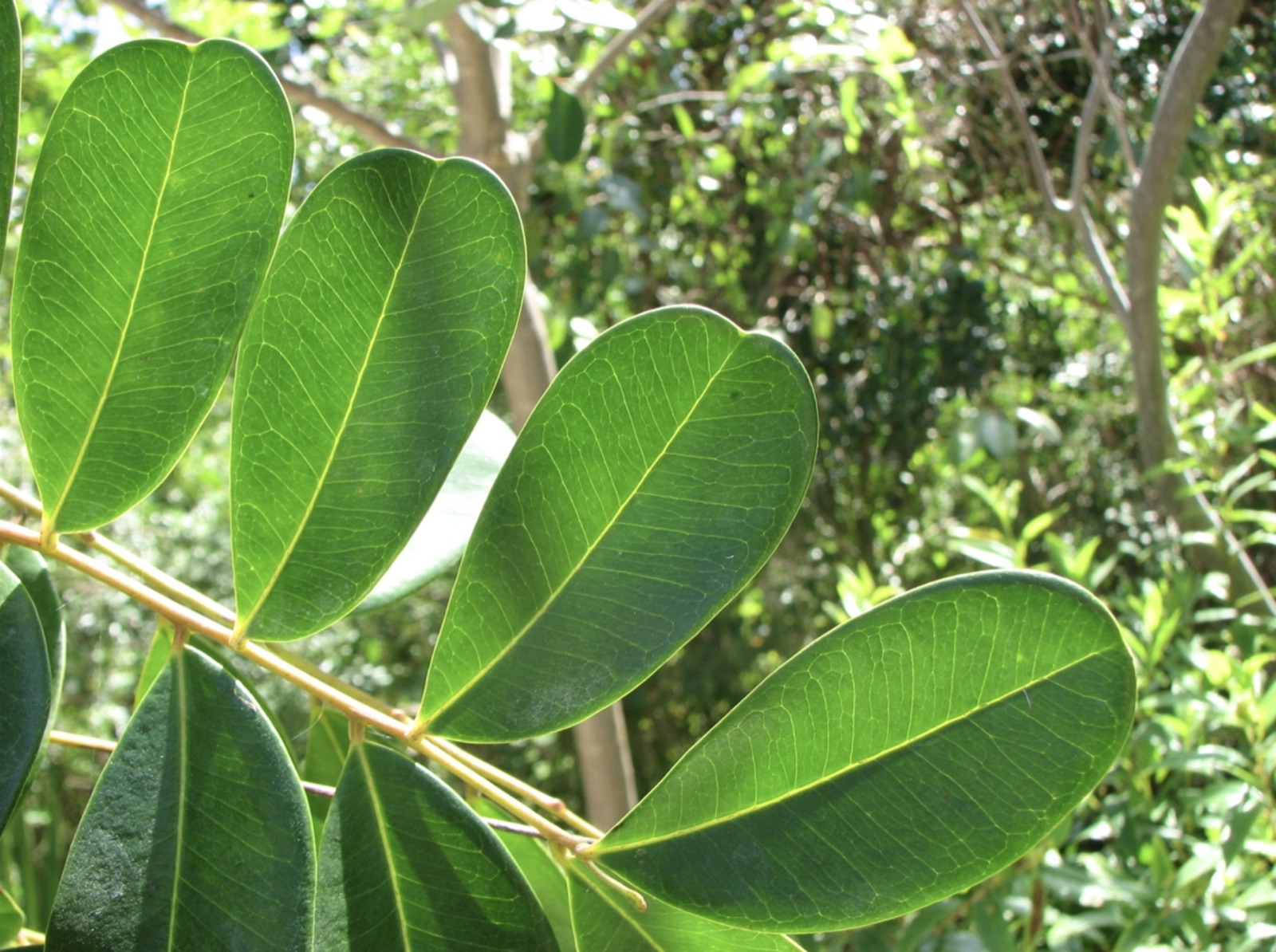 The compound leaf: oblong, leathery leaflets with rounded or notched tips, along a pale rachis. Photograph: Levy Preserve
Leaves. Alternate, compound and imparipinnate, with 5–8 pairs of leaflets. Each leaflet is oblong, leathery, with a rounded or notched tip, glossy dark green above and distinctly paler — glaucous, hence glauca — beneath. New flush is coppery-red.
Flowers. Small, 5-petalled, pale yellow to whitish, in loose branched panicles. Male, female and mixed flowers occur on separate trees — see male and female trees. Flowering is annual, beginning in December and continuing into February.
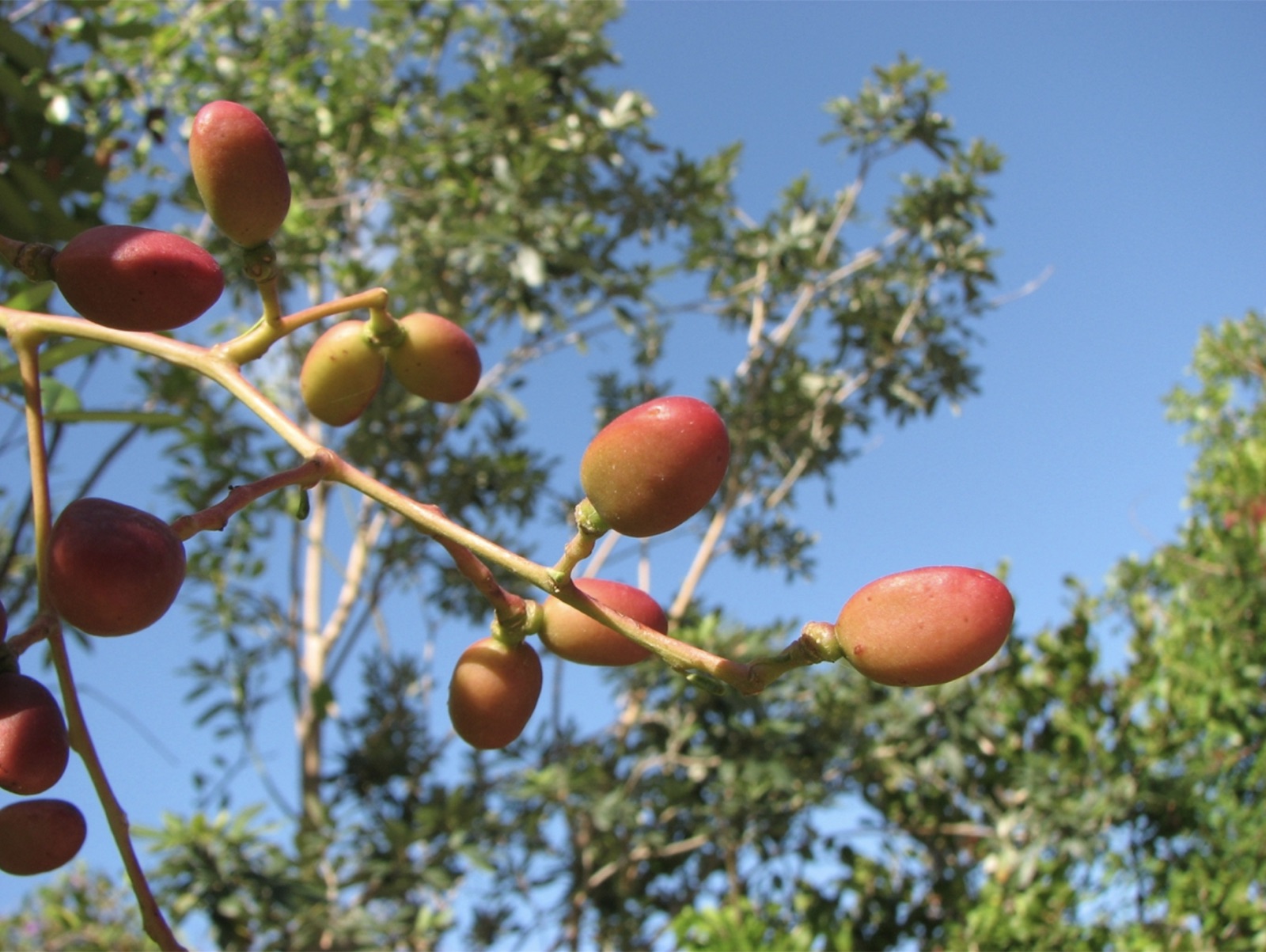 Fruit ripening on the panicle — green, then yellow-orange, then red, finally purple-black. Photograph: Levy Preserve
Fruit. An ellipsoid drupe, 2–2.5 cm long, with a thin hard skin and juicy pulp. Ripe colour depends on the genotype — blackish purple in pink types, brownish yellow in green types — passing through green and red on the way. The pulp is edible, sweet and faintly astringent. Each fruit carries one seed, of which roughly 70% is shell and 30% kernel; the kernel is the oil-bearing part. Fruit matures March into April.
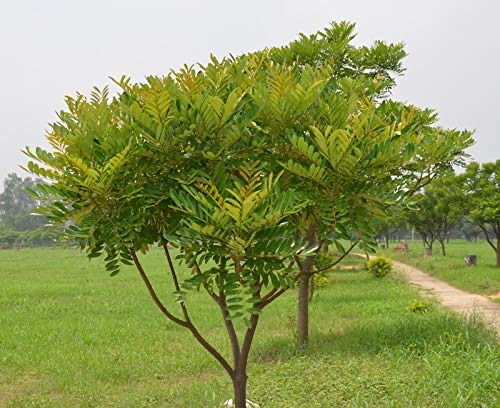 Habit: a young tree in the open, single-trunked with a spreading crown.
Bark. Smooth and grey-brown on young trees, becoming shallowly fissured with age. Bitter to taste throughout — the bitterness comes from quassinoids present across the whole plant.
Commonly confused with: Ailanthus excelsa (maharukh) and neem, both of which have compound leaves of a similar size. Simarouba is separated by its distinctly pale leaf undersides, rounded leaflet tips (neem's are toothed and pointed), and purple drupes.
The sex problem — read this before you plant
This is the single most important agronomic fact about Lakshmi Taru, and almost no Indian seller mentions it.
Simarouba glauca is polygamodioecious. A seedling becomes one of three kinds of tree: female (pistillate), which crops; mixed (andromonoecious), mostly male flowers with a few bisexual ones, which sets little; or male (staminate), which never fruits. Published proportions run roughly 40–50% female, 40–50% mixed and about 5% male.
A seedling's sex cannot be determined until it flowers — year 4 to 6. Plant 160 unsexed seedlings and close to half the block may never give a crop worth harvesting, discovered five years and roughly a lakh of rupees after planting.
What this means practically:
- Grafted planting material is worth a large premium. A graft from a known female mother tree is female. A seedling is a lottery ticket.
- You still need pollen. Pistillate trees carry none and cannot self. Published plantation guidance suggests about one mixed or male tree per twenty females, spread through the block. Pollination is by bees.
- Interrogate your nursery. Ask whether the material is grafted, and which mother tree the scion came from. If the seller cannot answer, it is unsexed seedling stock whatever the listing says.
Any yield or income projection for this tree silently assumes a correctly composed block. Applied to unsexed seedlings, projections are fiction.
Full detail: male and female trees.
Growing conditions
Climate. Warm humid to semi-arid tropics. Published rainfall figures vary a great deal — Indian sources give 500–2,200 mm, while international sources describe a preference for 2,000–3,000 mm with tolerance from 1,200–4,000 mm. Indian extension material also reports reasonable growth above about 300 mm of erratic rainfall, and tolerance of summer heat to 48–50 °C.
Read that spread honestly: the tree is genuinely adaptable, but it will grow in a dry district and crop well in a wetter one, and most Indian promotion quotes the survival figure while implying the yield of the wetter case.
Temperature. Indian sources give 17–35 °C; an international profile gives an optimum of 22–29 °C and tolerance of 18–34 °C. Not frost-hardy.
Altitude. Up to about 1,000 m by Indian accounts, 800–900 m by others. Above that, growth slows and bearing becomes unreliable.
Soil. Adapts to poor, shallow, gravelly and mildly saline soils where field crops fail — this is its main claim. It will not tolerate waterlogging. A deep taproot demands soil that drains; heavy black cotton soils with poor drainage are unsuitable.
pH. 5.5–8.0, with 6–8 preferred. Tolerates up to 8.5 by one account.
Where it does well in India: Karnataka (the largest planted area, centred on the UAS Bangalore promotion), Andhra Pradesh, Telangana, Tamil Nadu, southern Maharashtra, Odisha and parts of Madhya Pradesh and Chhattisgarh. North Indian winters are the limiting factor further up.
Where the sources disagree
This species has been promoted hard in India for thirty years, and the numbers in circulation are not consistent. Rather than pick the flattering figure, here is the spread.
| Indian extension (TNAU) | International profile (PFAF) | Our note | |
|---|---|---|---|
| Spacing | 6 × 6 m, 277 trees/ha (~112/acre) | — | 5 × 5 m (160/acre) is also widely quoted in India |
| Rainfall | 500–2,200 mm | prefers 2,000–3,000; tolerates 1,200–4,000 | Survival ≠ yield |
| Temperature | 17–35 °C | optimum 22–29 °C; tolerates 18–34 °C | |
| Altitude | up to 1,000 m | up to 800–900 m | |
| pH | 5.5–8.0 | prefers 6–8; tolerates 5.5–8.5 | Broad agreement |
| Oil content | 50–65% of seed | 60–75% of seed | Kernel basis usually 55–65% |
| Pollinator ratio | 1:6 | "not self-fertile" | A study of the species' polygamodioecy suggests 1:20 |
| Seed viability | 9–12 months in store without loss | "viability of only a few months" | Direct contradiction |
| Seed cake as feed | 64% protein, usable as cattle feed | manure use only | Unresolved — see Uses |
| Yield | 20 kg/tree from year 10 | 1,000–2,000 kg oil/ha/yr | Broadly compatible |
What to do with a table like this: plan on the pessimistic end of every row. The optimistic end is what gets quoted at you by someone selling saplings.
Uses
Kernel oil — the primary product. 55–65% of kernel weight, with 61% reported in analysis. Semi-solid at room temperature, and the fat profile is why: roughly oleic 52–56%, stearic 27–33%, palmitic 11–12%, giving about 41–43% saturated, 53–55% monounsaturated and only 2.5–3.4% polyunsaturated.
Indian material often describes it as comparable to olive oil. It is not. Olive oil is around 14% saturated; this is around 41%. The published ratio comparison is to palm oil, and the high stearic content makes it a candidate as a cocoa butter extender — a more interesting commercial route than the olive comparison, and an honest one.
Used in soap, cosmetics and pharmaceutical bases, and proposed as biodiesel feedstock, though at Indian seed prices the edible and cosmetic routes pay better.
Fruit pulp — edible fresh; can be made into juice, vinegar or wine. Thin, so it is a by-product rather than a crop.
Leaves — the traditional use in Central America is as a bitter decoction for dysentery and fever, which is the origin of the name "dysentery bark." This is also the product sold in India on health claims. See Simarouba leaves — what they are and how to judge them and what the research shows before consuming.
Seed cake — the residue after oil extraction, and a genuine point of disagreement between sources.
It is uncontroversially a good organic manure: reported at around 8% nitrogen, 1.1% phosphorus and 1.2% potash.
Whether it is livestock feed is not settled. Tamil Nadu Agricultural University's material describes the cake as around 64% protein and says it can be used as cattle feed. Other profiles list only manure use, and the whole plant is bitter with quassinoids, which is why related material is treated with caution.
Our position: do not feed it at scale on the strength of a web page — ours included. Get the cake analysed and take veterinary or animal-nutrition advice first. As manure it is useful and uncontentious, so that is what we describe it as.
Honey — the flowering panicles are attractive to bees. A December–February flowering window in a season when little else flowers makes plantations useful apiary sites, and honey is a genuine secondary income line.
Timber — light, soft, pale wood. Used for matchsticks, packing cases, plywood core and pulp. Low value; treat it as end-of-life salvage, not income.
Leaf litter and biomass — heavy, continuous leaf fall builds soil organic matter under the canopy. Reported biomass addition to wasteland is 10–15 t/ha/year, and pulp plus leaf litter is quoted at around 8 t/ha/year for vermicompost. This is a real agronomic benefit on degraded land and the strongest argument for the tree in afforestation.
Should you plant it?
Reasonable candidate if: you have marginal, well-drained land in peninsular India that is currently producing nothing; you can wait 5–6 years for income; you can source grafted, sexed planting material; and you have a realistic plan for who buys the seed.
Poor candidate if: you are replacing a producing crop; your land waterlogs; you are north of roughly the Vindhyas; you are buying into a plantation scheme that promises fixed buyback; or your projections depend on the tree's medicinal value.
The honest summary: Lakshmi Taru is a legitimate, low-input tree for degraded land, oversold for two decades by people with something to sell. The agronomy is sound. The marketing around it is not.
Run your own numbers before committing — the farming economics of Lakshmi Taru works through costs, yields and returns per acre, including the parts that usually go unmentioned.
Frequently asked questions
Is Lakshmi Taru the same as Simarouba glauca? Yes. Lakshmi Taru (or Laxmi Taru) is the Indian trade name for Simarouba glauca DC., also called the paradise tree or bitterwood.
Is the Lakshmi Taru fruit edible? The pulp is edible and mildly sweet. The seed kernel is the oil-bearing part and is pressed, not eaten raw.
How many years until Lakshmi Taru gives fruit? Four to six years from a seedling; somewhat earlier from a graft. Only female trees crop reliably.
How many Lakshmi Taru trees per acre? It depends on the spacing you follow, and published guidance differs: 5 × 5 m gives about 160 per acre (400/ha), while TNAU recommends 6 × 6 m, which is 277 per hectare or about 112 per acre.
Does Lakshmi Taru cure cancer? No. There is no clinical evidence that Lakshmi Taru treats cancer in humans. Laboratory studies of its quassinoid compounds show activity against cancer cells in vitro, which is not the same thing. See our full review of the research.
Can Lakshmi Taru grow in North India? Generally not reliably. It is not frost-hardy, and North Indian winters damage young plants. It suits peninsular and central India.
Is Lakshmi Taru seed cake good cattle feed? Sources disagree. TNAU describes it as around 64% protein and usable as cattle feed; other profiles list only manure use, and the plant is bitter with quassinoids throughout. Have the cake analysed and take animal-nutrition advice before feeding it at scale. As organic manure it is useful and uncontentious.
Sources to be attached before publication — see docs/SOURCES.md.